
Could Your HOA’s Reserves Be Hurting Your Condo’s Value?
Before you sell or refinance your condo, take a closer look at your HOA’s reserves
What condo owners (and buyers) need to know about the new lending rules
If you are a condo owner, you need to pay particular attention to the reserves of your Homeowners Association (HOA). You could be in for a big surprise if you decide to sell or refinance your condo.
Two recent Wall Street Journal drove this home. The first article talked about an big increase in the number of foreclosures being instituted by HOAs against owners who were late paying dues or contributing toward special assessments. These types of foreclosures are up 40% from two years earlier.
What condo owners need to know about new HOA reserve requirements
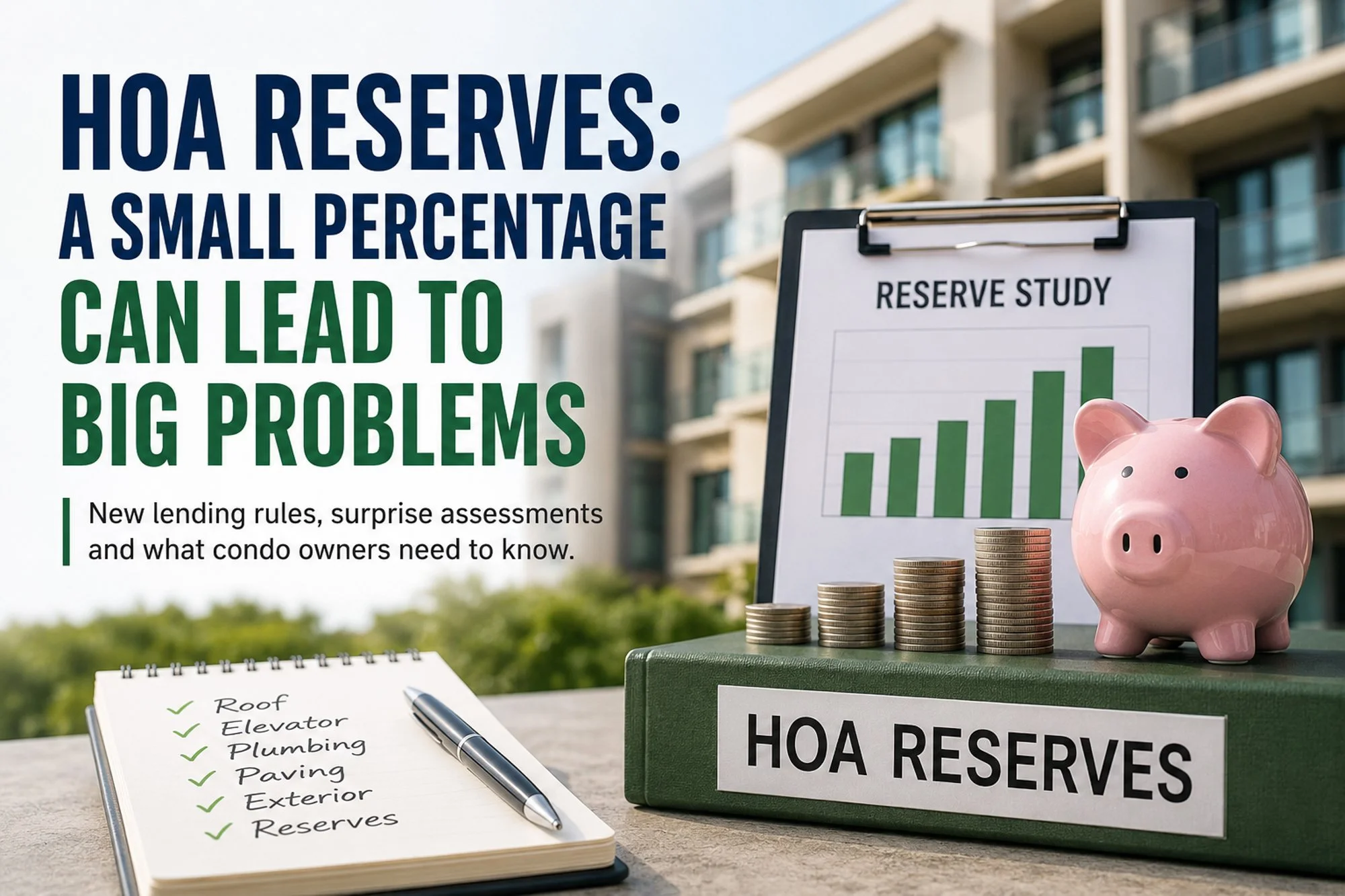
The second article outlined the new policy by Fannie Mae and Freddie Mac which will require condominium HOAs of ten units or higher to have a larger percentage of reserves saved. If HOA reserves dip below 15% of those mandated by required reserve studies, loans for these condominiums will not be considered for purchase by Freddie Mac and Fannie Mae.
How does this affect you as a condo owner? If a loan is non-conforming (see below), it becomes more expensive for buyers to purchase a home due to higher loan costs or interest rates. This effectively reduces the price of condos that do not conform to the reserve standards. Also, it will magnify the scrutiny on HOAs that have poorly funded reserves, making those less attractive to buyers.
For a little background, Freddie Mac and Fannie Mae were created to buy loans made by financial institutions, freeing up more funds for the institutions to make additional loans. Standards change over time. For 2026, according to the FHFA, the conforming loan limits for loans eligible to be purchased by Fannie Mae and Freddie Mac are:
Most California counties (baseline): $832,750
High-cost California counties (maximum): $1,249,125 for a one-unit property.
High cost counties include most Bay Area counties.
Low HOA reserves could mean higher dues, special assessments—and potential trouble when you sell
What are HOA reserves? Every three years associations are required to do a reserve study. This study looks at all the costs that will be required to maintain the buildings over a thirty year period. Things like roof replacement, concrete and stair maintenance, painting, repairs, etc. A number is placed on these requirements, based on how much of the useful life of those assets has been depleted. The HOA collects monthly fees from the owners and some amount is set aside for future costs. These are the reserves. The reserve percentage is the amount of reserves divided by the fully funded reserves determined in the reserve study. A reserve percentage less than 30% is considered poor. 30% to 70% is fair. Over 70% is considered good. This according to reserve specialists Association Reserves.
Why are low reserves bad? When a large capital expenditure arises for an HOA, like roof replacement, if there are not reserves to cover the expenses, a special assessment is billed to all owners. This one time charge can be difficult for some owners to absorb. For a buyer considering a purchase and using all their savings as down payment, they may be afraid to buy a unit with low reserves.
A buyer will request the reserve study as part of the HOA documents for review. Low reserves make it harder to justify paying a high price for the condominium.
Before you sell or refinance your condo, take a closer look at your HOA’s reserves
If you are considering selling your condo, request your latest reserve study from your HOA. It will tell you where your reserves stand. If you are a buyer, make sure you have an agent who understands reserves and other issues that can affect your long term costs in owning before you buy!
